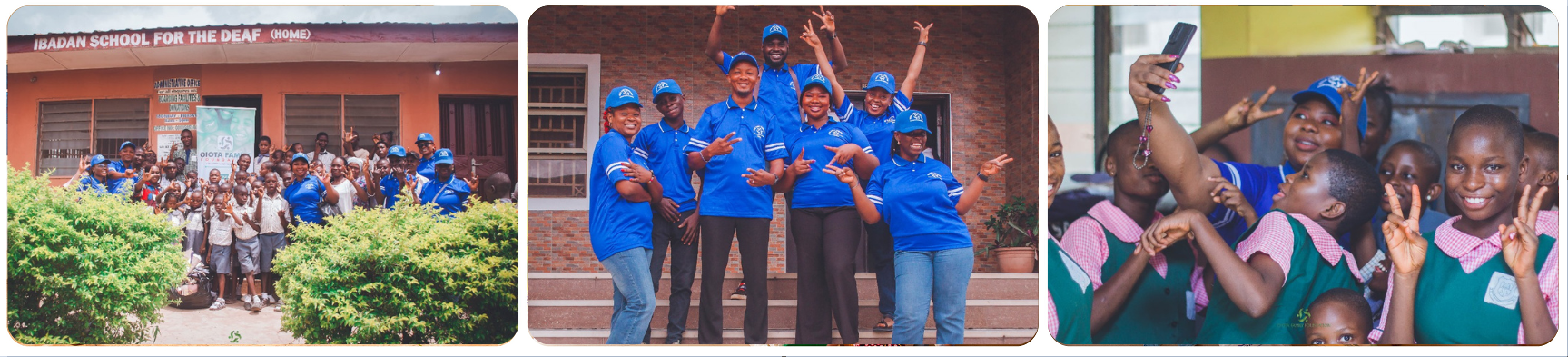
Three children sat outside the Home for Handicapped Children in Ibadan when our team arrived in 2025. They needed wheelchairs. They needed medical care. But what struck us most: they also needed books.
This moment captures the central failure of poverty intervention worldwide. We treat health and education as separate problems. We fund them through different channels. We measure their success independently.
The result: children get medicine but cannot read the labels. Students receive scholarships but miss school due to preventable illness. Communities build clinics without health literacy programs.
The OIOTA Family Foundation learned this truth through direct outreach across Nigeria and underserved communities in the United States. Our work at the Home for Handicapped Children, the Ibadan School for the Deaf, and our January 2026 Benin City Free Medical Outreach revealed a pattern. Poverty persists because interventions ignore the interconnected nature of human need.
Health problems create education barriers. Education gaps perpetuate health crises. Only holistic support breaks this cycle.
The Hidden Health Barrier to Education
A child with untreated vision problems sits in the back of a classroom in Benin City. The teacher writes lessons on the board. The child copies nothing. Teachers assume a lack of interest. Parents blame laziness. The real problem: the child cannot see the board.
This scenario repeated dozens of times during our January 2026 Benin City Free Medical Outreach. Our partnership with Azuwa Hospital and the Nigerian Women’s Association conducted eye screenings for 347 students. We found that 41% had uncorrected vision impairment affecting their academic performance.
These children attended school regularly. They sat through full class days. But they learned almost nothing. Their education failed not because schools lacked teachers or books. It failed because a simple health intervention never happened.
The pattern extends beyond vision. Our dental screenings at the same outreach revealed that 68% of children examined had untreated cavities causing chronic pain. Pain prevents concentration. Infection causes absence. Tooth loss affects nutrition, which impacts cognitive development.
The Education Gap in Healthcare Access
A mother in rural Benin City walks three hours to reach our medical outreach. She brings her daughter who has had a persistent cough for six months. When our medical team asks why she waited so long, her answer reveals the other side of the health-education divide: she did not know the cough required treatment.
Health literacy determines health outcomes. Our January 2026 outreach included community health education sessions alongside medical screenings. We discovered that 82% of attendees could not identify basic warning signs of common illnesses. They lacked the knowledge to seek timely care.
Our maternal health programs address this through targeted education. We train community health workers who speak local languages. They teach pregnant women about nutrition, danger signs, and the importance of facility delivery. The results: communities where we implemented these programs saw a 34% reduction in pregnancy complications over 18 months.
Creating Sustainable Change Together
The pattern repeats across all our outreach programs. Communities need health information as much as they need medicine. A clinic without health education serves patients once. Health education creates lasting behavior change that prevents future illness.
Together with our donors, volunteers, and medical partners, the OIOTA Family Foundation is pioneering an integrated support model where healthcare, schooling, and community education work side-by-side to break the cycle of generational poverty.